
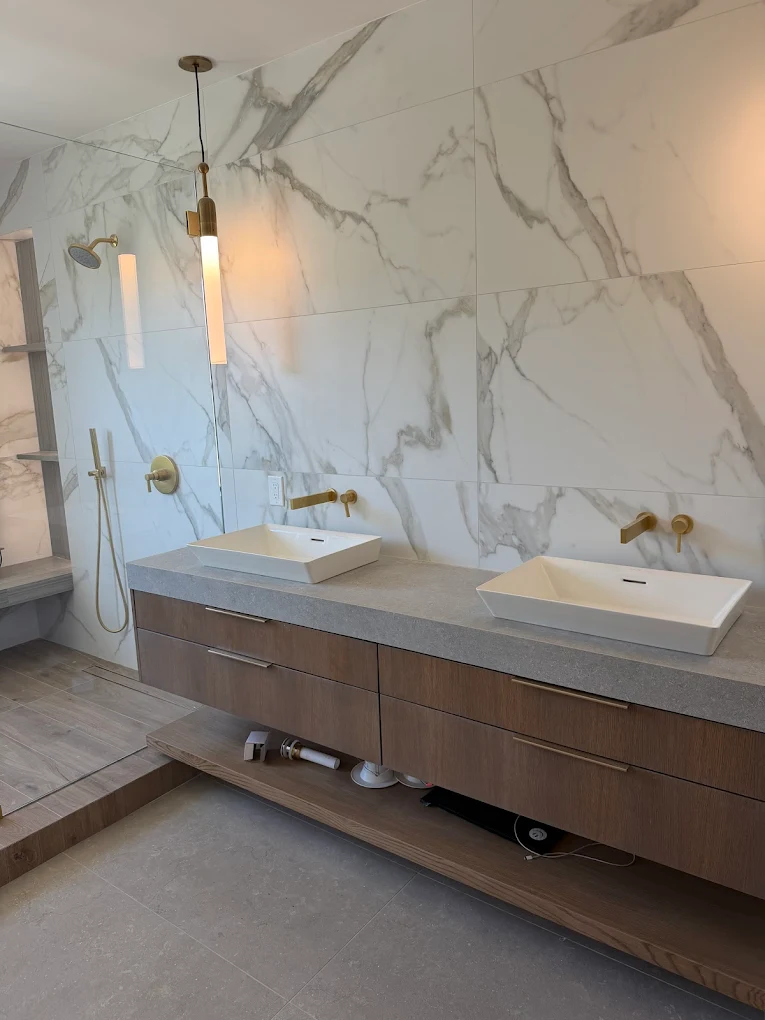
A bathroom remodel is one of the most technically demanding projects in a home. Unlike a kitchen, where most of the work is visible and accessible, a bathroom hides its most important systems inside walls, beneath the subfloor, and behind tile. In our experience across Los Angeles County, Ventura County, and Santa Barbara County, the bathroom remodels that hold up for decades are the ones where proper attention was paid to what happens before the finishes go on.
We have remodeled bathrooms in Pacific Palisades, Malibu, Calabasas, Thousand Oaks, Westlake Village, Oxnard, Camarillo, Santa Barbara, Montecito, Goleta, and Carpinteria. Each community has its own style and its own construction realities, but the technical standards for waterproofing, ventilation, plumbing, and electrical are consistent. Here is what we have learned from doing this work across Southern California.
What a Professional Bathroom Remodel Actually Involves
A professional bathroom remodel typically includes demolition down to the studs, inspection and repair of the underlying structure, replacement or relocation of plumbing supply and drain lines, electrical rewiring to meet current code, installation of a new waterproofing system, and then the finish work of tile, cabinetry, lighting, fixtures, and accessories.
In Los Angeles County, we frequently work with homes built between 1950 and 1980 that have never been updated. These bathrooms often have galvanized steel plumbing that is corroding internally, weak subfloors from past moisture exposure, and electrical systems that predate GFCI requirements. When we open the walls, we find conditions that have been hidden for decades. This is why we recommend a full demolition rather than a surface update for any bathroom that has not been remodeled in the last thirty years.
In Ventura County, many homes from the 1960s and 1970s have bathrooms with cultured marble surrounds, drop-in tubs, and pink or green tile. These are structurally sound but functionally obsolete. The tile work was often done directly over greenboard drywall with no waterproofing membrane. When we tear these out, we typically find moisture damage in the wall cavities that needs to be addressed.
In Santa Barbara County, especially in Montecito and Goleta, we see older homes with plaster and lath construction, which requires different demolition techniques than drywall. The plumbing in these homes is often copper with lead solder joints that may not meet current code for new work. We test everything before we close the walls.
Waterproofing Standards in California — What Code Requires
California building code requires that shower enclosures be constructed with a continuous waterproof membrane behind the tile, extending from the shower floor to at least three inches above the showerhead height. This means the entire shower area walls must be protected, not just the lower portion. The shower floor must be sloped at a minimum of one-quarter inch per foot toward the drain, and a corrosion-resistant drain flange must be installed at the proper height relative to the waterproof membrane.
In practical terms, this means the shower is built as a waterproof vessel before a single tile is installed. We use either a hot-mop system (built-up asphalt and fabric layers) or a sheet membrane system like Schluter-Kerdi, depending on the project requirements. Both methods are code-compliant and proven, but they require different installation techniques and cure times.
Hot-mopping is still common in Southern California because it has been used for decades and local building inspectors are familiar with it. A hot-mop involves applying layers of hot asphalt and building felt to create a seamless waterproof pan. It cures quickly and is relatively inexpensive, but it must be installed by a specialized crew. Sheet membrane systems are more common in modern construction because they are thinner, lighter, and allow for more precise slope control. They require the installer to follow the manufacturer's installation instructions exactly, including the use of proprietary sealants and corner pieces.
Common Waterproofing Mistakes We See in the Field
The most common mistake we see is improperly sealed corners and penetrations. Where the shower floor meets the wall, where a niche is cut into the framing, and where the shower valve protrudes through the membrane are all points where water can bypass the waterproofing if not detailed correctly. We also find curbless shower installations where the slope was not maintained across the entire floor area, allowing water to pool outside the shower footprint.
Another frequent issue is the absence of a proper vapor barrier behind cement board on exterior walls. In coastal areas like Malibu, Pacific Palisades, and Santa Barbara, moisture drives through exterior walls from the outside as well as from the shower. If the wall assembly does not include a vapor retarder on the correct side of the insulation, condensation can form inside the wall cavity and cause mold growth.
We also see tile installed directly over greenboard drywall in older bathrooms that have been partially updated. Greenboard is moisture-resistant, not waterproof, and it will deteriorate over time when exposed to direct water. California code requires cement board, fiber-cement board, or another approved substrate behind tile in wet areas, not greenboard.
Ventilation Requirements Under California Building Code
California's building code is explicit about bathroom ventilation. Every bathroom with a shower or tub must have an exhaust fan vented to the exterior. The fan must be sized to provide a minimum of 50 cubic feet per minute for bathrooms under 100 square feet, or a larger fan sized according to the room volume for larger spaces. The fan must be vented with smooth-walled ductwork to the outside, not into the attic or a soffit.
This is one of the most common deficiencies we find in older bathrooms across Los Angeles County. We regularly open up bathroom ceilings and find a fan housing that is not connected to any duct, or a flexible plastic duct that runs a few feet into the attic and terminates in a pile of insulation. In Calabasas and Thousand Oaks, where attics are common, we have seen fans that were never connected to anything. The fan made noise but did nothing to remove moisture.
A properly installed ventilation system does more than prevent mold. It protects the paint and drywall from peeling, prevents mirrors from fogging, reduces the load on the HVAC system, and extends the life of bathroom fixtures and finishes. In luxury bathroom remodels, we often install humidity-sensing fans that automatically activate when the humidity level rises, providing protection without the homeowner having to remember to turn the fan on.
Plumbing and Electrical Considerations for Bathroom Remodels
Every bathroom remodel that involves relocating fixtures requires new plumbing work that must comply with the California Plumbing Code. Supply lines must be sized correctly for the fixtures being installed, and drain lines must maintain proper slope and venting. Moving a toilet even a few feet can require cutting into the slab or modifying the floor joists to accommodate new drain routing.
We recently completed a bathroom remodel in a Pacific Palisades home where the homeowner wanted to relocate the toilet by four feet. The existing toilet was on a concrete slab foundation, which meant we had to core through the slab, run new drain lines under the house, and patch the concrete. The plumbing rough-in took three days and required coordination with a structural engineer to verify that the slab cuts did not affect the foundation integrity.
Electrical work in bathrooms is governed by specific code requirements that differ from the rest of the house. California adopted the 2020 National Electrical Code with amendments, and these requirements apply to any bathroom remodel that involves new wiring.
GFCI, Dedicated Circuits, and Moisture-Rated Fixtures
All bathroom outlets must be GFCI-protected. This includes outlets near the vanity, outlets in the water closet, and any outlet within six feet of a water source. The GFCI protection can be provided by a GFCI breaker at the panel or by GFCI receptacles at each location.
Bathrooms require a dedicated 20-amp circuit for the outlet receptacles. This circuit cannot serve any other room. Lighting and exhaust fans can be on the same circuit as the receptacles or on a separate circuit, but they must be protected by the same GFCI requirements if they are within the same wet area.
Light fixtures in shower enclosures must be rated for damp or wet locations, depending on their proximity to the water spray. A light fixture directly above the shower stream must be wet-rated. A fixture outside the shower but within the bathroom can be damp-rated. We have seen homeowners select beautiful light fixtures that are not rated for bathroom use, which creates both a safety hazard and a code violation.
In Malibu and Santa Barbara, where power outages are more common due to fire season and coastal storms, we often install battery-backed GFCI outlets and consider generator or battery backup for lighting in the bathroom. This is not a code requirement, but it is a practical consideration for homeowners in these areas.
Subfloor and Structural Work — What Lies Beneath
The subfloor in a bathroom must be capable of supporting the weight of tile, stone, a tub filled with water, and the occupants. This is a significant load. If the existing subfloor is particle board, oriented strand board that has been exposed to moisture, or dimensional lumber with excessive span, it will flex under the tile and cause cracking.
California code requires that the deflection of the subfloor be limited to L/360 for tile and L/720 for natural stone. This means the subfloor can flex no more than one three-hundred-sixtieth of the span for tile, and half that for stone. In practice, this often means adding a layer of plywood underlayment, installing additional joist supports, or both.
We inspect the subfloor in every bathroom remodel before any tile work begins. In Goleta and Carpinteria, where many homes are built on raised foundations, we have access to the joists from below and can add sister joists or bridging to stiffen the floor. In Oxnard and Camarillo, where slab foundations are common, we verify that the slab is sound and that the mortar bed or uncoupling membrane is installed correctly.
Bathroom Remodel Cost Ranges by County (2026)
Bathroom remodel costs vary significantly depending on the scope, the size of the bathroom, and the county where the work is performed. Here are the ranges we see in 2026 across our service areas.
Los Angeles County: A powder room remodel runs $12,000 to $20,000. A full guest bathroom remodel runs $25,000 to $45,000. A master bathroom remodel with custom tile, curbless shower, double vanity, and premium fixtures runs $50,000 to $90,000. In Pacific Palisades, Malibu, and Calabasas, where material costs and labor rates are higher, we see master bathroom remodels at the top end of this range or above.
Ventura County: Costs are generally 10 to 15 percent lower than Los Angeles County. A full guest bathroom remodel in Thousand Oaks, Westlake Village, Camarillo, or Oxnard runs $20,000 to $38,000. A master bathroom remodel runs $40,000 to $75,000. The difference is driven primarily by labor rates and subcontractor pricing rather than material costs.
Santa Barbara County: Costs are comparable to Los Angeles County for similar scope. A full bathroom remodel in Santa Barbara, Montecito, or Goleta typically runs $25,000 to $48,000 for a guest bath and $50,000 to $95,000 for a master bath. In Montecito, where older homes often require more structural work and custom finishes, we have seen master bathroom remodels exceed $100,000.
Contractor Selection for Bathroom Remodels in LA, Ventura, and Santa Barbara
Choosing the right contractor for a bathroom remodel is different from choosing one for a kitchen or an addition. Bathroom work is detail-intensive, and small mistakes in waterproofing, drainage slope, or tile layout can have consequences that do not appear until years later. A contractor who specializes in bathroom remodels or has significant experience with wet-area construction is worth finding.
We recommend homeowners verify that the contractor carries a valid California contractor license (CSLB), general liability insurance, and workers' compensation coverage. For bathroom remodels, we also recommend asking about the specific waterproofing system the contractor uses and whether they are certified by the manufacturer to install it. Schluter Systems, for example, offers installer certification for its Kerdi and Ditra products. A certified installer has demonstrated proficiency with the system.
Ask for references from bathroom remodels completed within the last year, and visit those bathrooms if possible. Look at the tile work. Check the caulking at the changes of plane where walls meet floors and where niches meet walls. Open the shower door and check whether water pools on the floor outside the shower. These details reveal the quality of the installation.
EG Construction is a California-licensed contractor (CSLB #1154478) with extensive bathroom remodel experience across Los Angeles County, Ventura County, and Santa Barbara County. If you are planning a bathroom remodel, we would welcome the opportunity to review your project, discuss your goals, and help you understand what the work will involve. Contact us to schedule a consultation, or learn more about our bathroom remodeling services.