
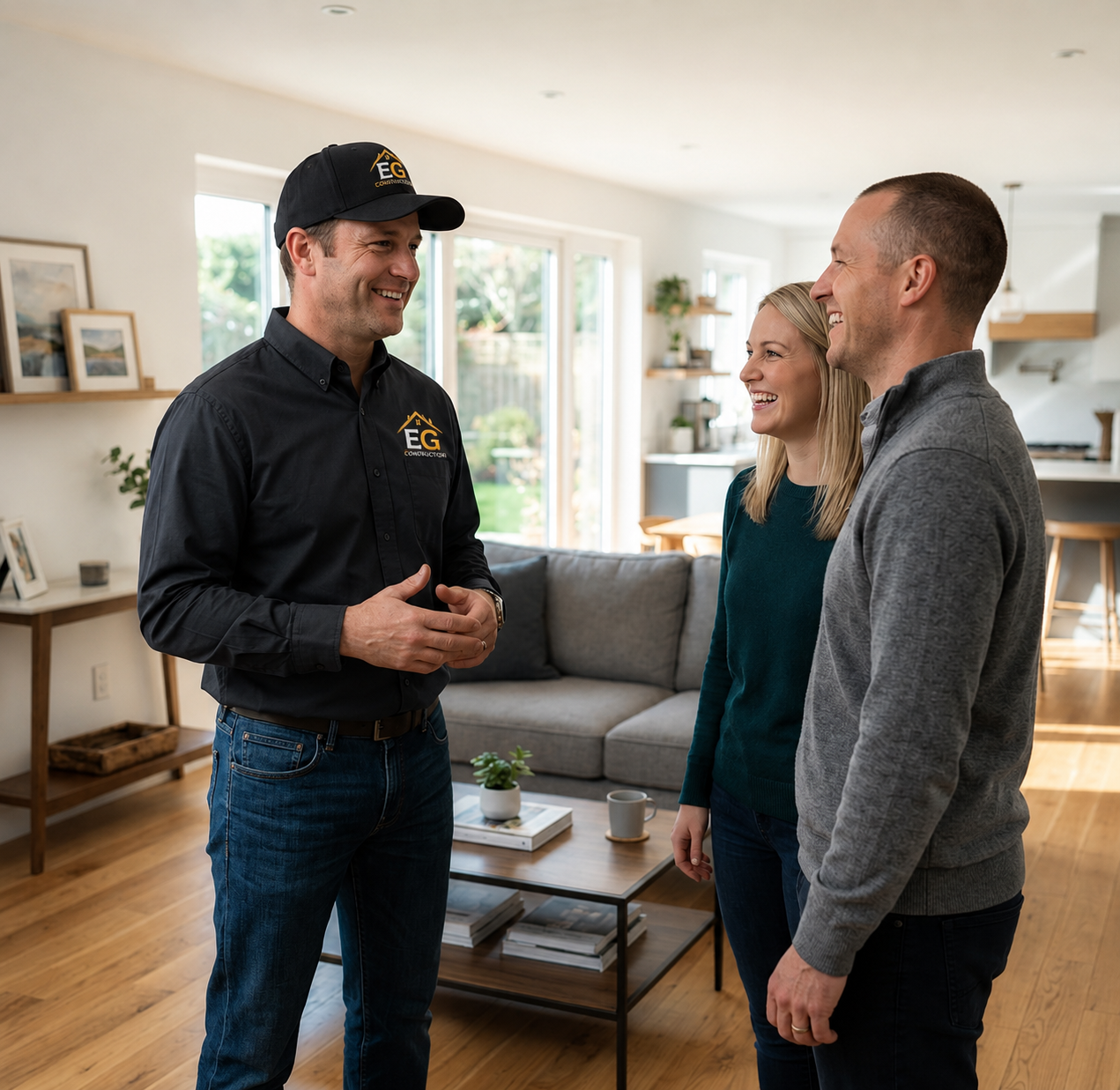

Building a custom home on the Central and South Coast of California is one of the most rewarding investments a family can make. Unlike buying a production home in a subdivision, a custom home gives you complete control over the design, materials, systems, and finishes. Every detail reflects how you want to live. But the process of getting from raw land to a finished home is complex, and the contractors, jurisdictions, and environmental conditions vary dramatically across Santa Barbara County, Ventura County, and Los Angeles County.
As a custom home builder serving Montecito, Goleta, Carpinteria, Oxnard, Camarillo, Thousand Oaks, Westlake Village, Malibu, Calabasas, and Pacific Palisades, EG Construction brings firsthand experience with the specific challenges each location presents. This guide walks through what you need to know before breaking ground on your custom home.
Building a Custom Home on the Central and South Coast
California's Central and South Coast offers some of the most desirable building sites in the country, but those sites come with constraints that affect every decision you make. Hillside lots require careful grading and foundation engineering. Coastal properties trigger California Coastal Commission review and coastal development permit requirements. Inland sites may have agricultural zoning, well and septic considerations, or utility extension challenges. And across every location, seismic design is non-negotiable.
The California Building Standards Code (Title 24) governs all new home construction, including structural design, energy efficiency, fire protection, plumbing, electrical, and mechanical systems. Chapter 16 of the California Building Code addresses structural design requirements for seismic forces, which is especially relevant in our region. Site-specific geotechnical investigations are required for all new homes, and the findings directly influence foundation type, retaining wall design, and slab reinforcement. In hillside areas of Montecito and Malibu, we have designed foundations that resist both seismic lateral forces and debris flow impact loads.
Energy compliance under Title 24's 2025 Energy Code requires that new homes achieve net-zero energy performance through a combination of high-performance building envelopes, efficient HVAC systems, LED lighting, and photovoltaic solar generation. The California Energy Commission updates these requirements periodically, and the standards in effect when you pull your permit will determine the specific compliance path your project must follow. Working with a contractor who understands current energy code requirements is essential to avoid costly redesigns during plan check.
Site Selection in Santa Barbara, Ventura, and LA Counties
Site selection is the single most consequential decision in any custom home project. The right site reduces construction costs, simplifies permitting, and results in a home that performs better and is more comfortable to live in. The wrong site can turn a dream project into a years-long ordeal. We evaluate every potential building site for soil stability, slope gradient, drainage patterns, access for construction equipment, utility availability, solar exposure, views, privacy, and proximity to wildfire hazard zones.
In Santa Barbara County, available building sites often involve hillside terrain, oak woodland habitats, or coastal proximity. The County's Article II hillside development standards impose strict limits on grading, vegetation removal, and building footprint on slopes exceeding certain percentages. In Montecito, additional requirements from the Montecito Planning Commission address debris flow safety, including the need for debris catchment basins, reinforced walls, and emergency access routes. These requirements add cost but are essential for safety in a community that experienced devastating debris flows in 2018.
Ventura County offers a mix of coastal, valley, and foothill sites. The Cities of Oxnard, Camarillo, and Thousand Oaks each have their own general plans and zoning codes that affect allowable density, building height, setbacks, and design review requirements. Thousand Oaks requires design review approval for new custom homes in many of its residential neighborhoods, with guidelines addressing architectural style, materials, colors, and landscaping. We help clients navigate these local design review processes by preparing submittal packages that clearly demonstrate compliance with community design standards.
Los Angeles County presents the most variable permitting landscape. Unincorporated county areas follow Title 26 of the LA County Code, while cities like Calabasas, Malibu, and Westlake Village have their own municipal codes. Malibu's Local Coastal Program adds another layer of regulation, requiring Coastal Development Permits for most new construction. Properties in Very High Fire Hazard Severity Zones throughout LA County must comply with Chapter 7A of the California Building Code, which mandates ignition-resistant construction materials and assemblies for roofs, eaves, siding, windows, and decks.
Coastal Commission and Environmental Review
If your building site is within the Coastal Zone, which includes most coastal properties in Santa Barbara, Ventura, and Los Angeles counties, you will need a Coastal Development Permit from either the local government or the California Coastal Commission. The Coastal Act requires that new development protect public access, scenic views, marine resources, and sensitive habitats. The permitting process involves a public notice period, review by Coastal Commission staff, and potentially a public hearing before the Commission or its local equivalent.
Environmental review under the California Environmental Quality Act may also be triggered for custom home projects, particularly if the site contains sensitive biological resources, cultural resources, or if the project involves significant grading or vegetation removal. In our experience working on coastal properties in Carpinteria and Malibu, environmental review adds three to six months to the pre-construction timeline and requires specialized consultants for biological assessments, archaeological surveys, and geotechnical reports. Planning for these requirements from the start prevents delays later in the process.
Designing for California's Energy Code (Title 24)
Title 24's Building Energy Efficiency Standards are among the most stringent in the United States, and the 2025 code cycle continues California's trajectory toward net-zero energy homes. For new custom homes, compliance is typically achieved through the performance approach, which uses energy modeling software to demonstrate that the proposed building design meets or exceeds the energy budget for a standard reference design. Key design strategies include continuous insulation in walls and roofs, high-performance dual-pane low-E windows, air sealing details that reduce infiltration to code-mandated levels, high-efficiency heat pumps for space conditioning and water heating, LED lighting throughout, and a photovoltaic solar system sized to offset the home's projected energy use.
Solar panel installation is now mandatory for virtually all new homes in California. The solar PV system must be sized to provide enough electricity to meet the home's annual energy load, and the system must be interconnected with the local utility grid. Battery storage is not currently required by code, but many homeowners in our service area choose to include battery backup for resilience during Public Safety Power Shutoffs, which have become common during high fire risk conditions in Ventura and Los Angeles counties.
The energy code also affects window placement and glazing. West-facing glass area is limited because of the heat gain penalty. Shading strategies, including overhangs, awnings, and exterior shades, are factored into the energy model and can offset some of the penalties associated with larger window areas. We coordinate with architects and energy consultants during the design phase to optimize the building envelope for energy performance before the plans are finalized.
Budget Planning for Custom Homes (2026)
Custom home construction in California costs more per square foot than almost any other region in the country, and 2026 pricing reflects ongoing labor shortages, material supply chain dynamics, and code compliance costs. For a custom home in Santa Barbara County, Ventura County, or Los Angeles County, homeowners should expect to invest $450 to $800 per square foot for a fully finished home, depending on the complexity of the design, quality of finishes, and site conditions. This range includes site work, foundation, framing, roofing, mechanical systems, interior finishes, cabinets, countertops, flooring, plumbing fixtures, and the mandatory solar PV system.
A 10 to 15 percent construction contingency is standard for custom homes, and we recommend our clients set aside an additional 5 percent for post-construction landscaping, fencing, driveways, and outdoor amenities that are often not included in the initial construction budget. Soft costs, including architectural design fees, structural engineering, geotechnical investigation, energy consulting, permit fees, and impact fees, typically add 12 to 18 percent to the total project cost.
Financing a custom home build is different from financing a home purchase. Construction loans provide funds in draws as work progresses, and they convert to permanent mortgages after the certificate of occupancy is issued. We work closely with our clients' lenders to provide the documentation needed for construction loan approval, including detailed cost estimates, construction schedules, and builder qualifications.
Permitting Timelines by County
Permitting timelines vary significantly across our service area, and understanding these differences helps set realistic expectations for your project timeline. Santa Barbara County Building & Safety typically processes custom home permits in four to eight months for properties that do not require Coastal Commission approval. Projects in Montecito that require Planning Commission review can take six to twelve months. Ventura County's Building & Safety division processes residential permits in three to six months for standard projects, though the City of Thousand Oaks and City of Camarillo each have their own timelines that may be shorter or longer depending on current workload.
Los Angeles County has the widest range of permitting timelines. Unincorporated county permits through the Department of Regional Planning can take six to twelve months for custom homes. Malibu permits require Coastal Development Permit approval, which adds three to six months to the timeline. Calabasas permits require Planning Commission design review, typically adding two to four months. We track current processing times at each jurisdiction and build realistic schedules that account for plan check cycles, resubmittal time, and inspection availability. Our project managers handle all communication with building departments so our clients can focus on design and material decisions.
Material Selection and Lead Times
Custom home construction in 2026 continues to be affected by material lead times that require early ordering and careful logistics planning. Custom windows and doors have lead times of 12 to 20 weeks. Structural steel, if required for long spans or seismic bracing, must be ordered eight to twelve weeks before it is needed on site. Cabinetry, countertops, and tile selections need to be finalized before framing is complete to avoid delays later in the project.
We provide our clients with a material decision schedule that specifies when each product and finish must be selected, ordered, and delivered. This schedule is tied to the construction timeline and accounts for lead times that we track and update regularly. For clients building in Malibu and Pacific Palisades, where wildfire risk influences material choices, we specify ignition-resistant materials that meet Chapter 7A requirements and source them through suppliers with reliable delivery records.
Sustainable and locally sourced materials are increasingly important to our clients. Reclaimed wood, locally quarried stone, and low-VOC finishes are common specifications in custom homes across Santa Barbara and Ventura counties. We maintain relationships with suppliers who can provide these materials and verify their compliance with California's volatile organic compound regulations and green building standards.
The Contractor's Role Throughout the Build
A custom home builder does far more than manage subcontractors. From site selection through final walkthrough, the contractor is responsible for every aspect of the project. During pre-construction, we help clients evaluate building sites, assemble the design team, develop the budget, secure financing documentation, and navigate the permitting process. During construction, we manage the schedule, coordinate trades, order materials, enforce quality standards, track changes, and communicate progress to the client.
Quality control is a continuous process on every custom home we build. We conduct weekly site walks with our project managers and superintendents, review work against the construction documents before each trade finishes, and perform pre-drywall and pre-closeout inspections with the client. We photograph every phase of construction and maintain a digital record of what is behind every wall, under every floor, and above every ceiling. This documentation is invaluable for future maintenance and renovations.
Change orders are a reality in custom home construction. Despite thorough planning, homeowners often decide to modify details once they see framing in place or once finish materials are presented in the actual space. We manage changes through a formal change order process that documents the change, provides a cost and schedule impact, and requires client approval before work proceeds. This transparency prevents disputes and keeps the project moving.
Why Local Knowledge Matters for Custom Home Construction
The difference between a smooth custom home build and a difficult one often comes down to the contractor's familiarity with local conditions. Every jurisdiction in our service area has its own interpretation of building codes, its own plan check requirements, its own inspection protocols, and its own relationships with utility providers, fire departments, and school districts. A contractor who has built in the area for years knows which engineering firms the local building department trusts, which soils engineers are familiar with the local geology, and which inspectors expect specific details at rough-in inspections.
Local knowledge also extends to subcontractor relationships. The best concrete contractors, framers, roofers, electricians, plumbers, drywall finishers, painters, and finish carpenters in Santa Barbara, Ventura, and Los Angeles counties are often booked months in advance. We maintain relationships with experienced tradespeople who have worked on our projects for years and who understand the quality standards we require. When we schedule a custom home, we book key trades during the design phase so their availability is secured before the permit is even issued.
And finally, local knowledge means understanding the climate, the terrain, and the lifestyle that makes each community unique. A home designed for the coastal fog of Goleta needs different window and HVAC specifications than a home designed for the inland heat of Thousand Oaks. A property in the Malibu hills requires different fire protection and access considerations than a lot in an Oxnard coastal neighborhood. We bring this context to every project, and it is why homeowners trust EG Construction with their custom home.
EG Construction is a California-licensed custom home builder (CSLB #1154478) serving Santa Barbara County, Ventura County, and Los Angeles County. Visit our new home construction service page to learn more about our process, or contact us to discuss your custom home project.